This article represents the third entry in our continuing series dedicated to Formula 1 racing strategy terminology.

Within the context of Formula 1 race weekends, the "Free Practice”sessions are of utmost importance. These sessions, designated as FP1, FP2, and FP3, provide drivers with essential opportunities to analyze track conditions, optimize car setups, evaluate tire performance, and strategically prepare for both qualifying and the race. Generally, two one-hour free practice sessions (FP1 and FP2) are held on Friday, followed by a final one-hour session (FP3) on Saturday prior to qualifying.
The “qualifying procedure” is a three-part, elimination-style session held on Saturday, designed to determine the starting grid for the Grand Prix. The fastest lap time achieved during Qualifying secures "Pole Position," the premier grid position. For Sprint weekends, an additional Sprint Qualifying session is scheduled on Friday to establish the grid for the Sprint race.
The strategically significant "Pole Position," the foremost starting position on the grid, is awarded. to the driver who attains the fastest lap time during the third and final qualifying segment (Q3).
Overcut/Undercut presents an engaging race strategy, wherein a driver seeks to overtake a competitor during a pit stop phase. An effective overcut strategy entails the trailing driver pitting subsequent to the leading car, leveraging superior lap times on an unobstructed track to secure a position ahead upon their subsequent pit stop. Conversely, a successful undercut strategy involves the pursuing driver pitting ahead of the leading car, capitalizing on fresher tires to gain track position upon the competitor's pit stop.
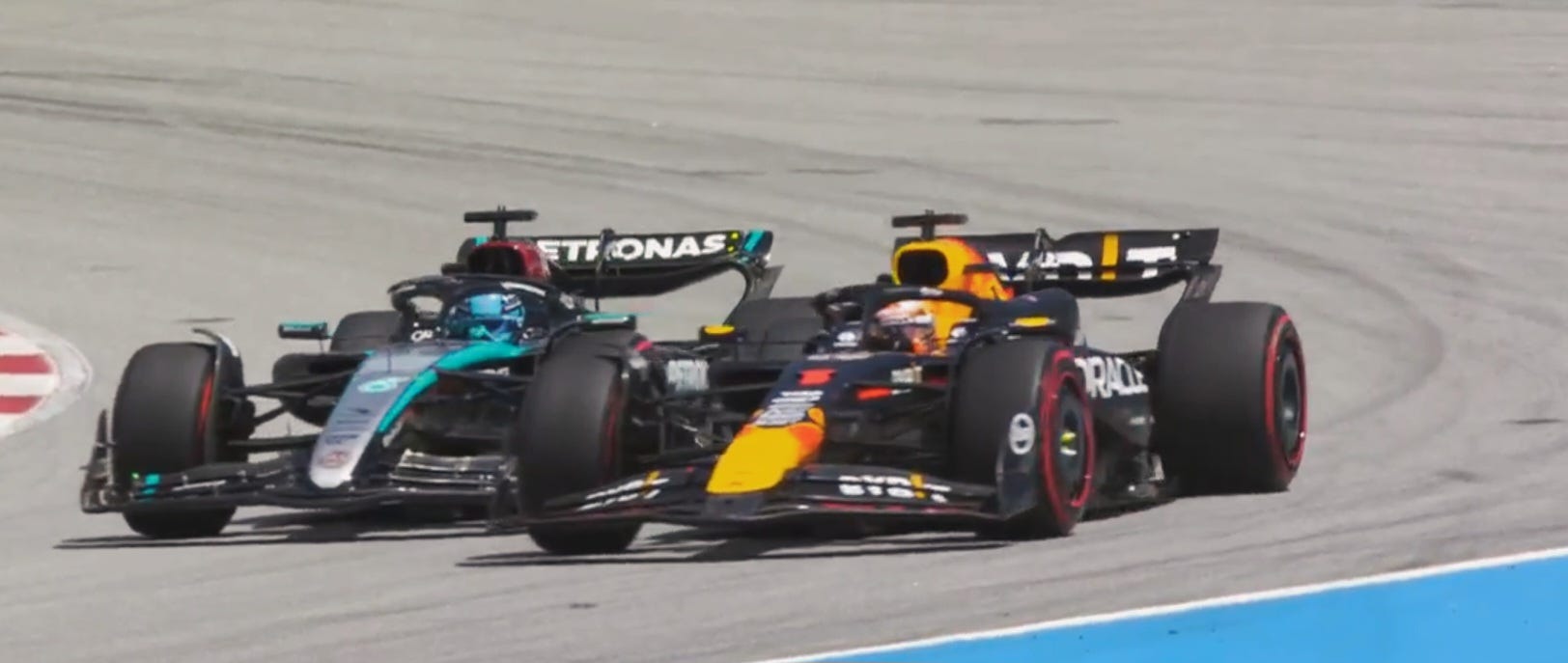
In Formula 1, the term "slipstream dynamics" refers to a technical concept primarily utilized on the straight sections of a circuit. A trailing vehicle can exploit the slipstream, or draft, effect. This occurs due to the low-pressure zone generated by the lead car, which subsequently reduces the power needed for the trailing car to maintain its speed. This technique is beneficial for overtaking and has been strategically used by teammates during qualifying. Conversely, the aerodynamic forces of slipstreaming in corners create "dirty air," which can negatively impact the following car's performance and complicate overtaking.
The implementation of the "double stacking" strategy presents Formula 1 teams with a complex set of challenges. This strategy, which involves two cars entering the pit lane simultaneously for tire changes and adjustments, necessitates precise coordination to avoid significant time penalties. Although frequently employed in response to safety car periods or strategic opportunities, its application extends beyond Formula 1. The strategic implications of double stacking and related pit stop procedures can have a considerable impact on race outcomes.
The "pit area,” encompassing team garages, is a crucial element of a race circuit. fulfilling various strategic functions. Access to the pits is managed via the pit lane, a designated circuit segment subject to speed limitations (from pit entry to pit exit). During a race, drivers utilize the pit lane to stop at their team's garage for pit stops, which may include tire changes or mechanical repairs. Key team personnel are positioned on the pit wall, located trackside adjacent to the pit lane. These individuals utilize specialized stations equipped with computer systems to monitor car performance throughout practice, qualifying, and the race.
The Formula "Safety car" is a critical component of the sport, strategically advantageous when utilized effectively by drivers and their teams. Its deployment is triggered by hazardous track conditions, such as incidents or debris. During its deployment, drivers must maintain a specific distance from the safety car to facilitate safe track clearance and repair operations by marshals. Racing activities resume once the track is deemed safe and the safety car withdraws.
The Belgian Grand Prix, scheduled for July 25-27, marks the commencement of the second half of the season's race calendar.